My favorite teacher in school was never the art teacher because I never took art. It was the stern-looking physics instructor who rode a motorcycle to school and, if memory serves, wore a pocket protector. (That last detail I may have imagined, but you need it to get the picture.)
His tests and quizzes never asked us simply to repeat formulas. Instead, he invented scenarios and asked us to apply the principles we’d learned. We predicted outcomes. We learned that the world had rules, that if you understood them well enough, you could make sense of what happened.
I hung on every word he spoke. What was this clear-cut, rational world he so calmly explained, occasionally illustrating with a red dry erase marker across an expansive whiteboard? I wanted in.
And then one day he wrote a proverb on that same board.
“Man plans, God laughs.”
I don’t remember him saying much about it, but I’ve been thinking about those four words ever since.
Back then, I understood them as a commentary on human folly—our smallness in the face of an all-knowing God. It felt more frustrating than comforting.
Then I graduated from high school and began building a life of my own.
I had plans. I would earn a Ph.D. in American Literature. I would marry once. I would have several children, children I could only imagine as daughters because I knew what it was to be one. I had a sister. I was close to my mom. Without ever questioning it, I assumed motherhood would look something like the family I had grown up in. It’s the only version of motherhood I had ever experienced from the inside.
Life, it turned out, wasn’t nearly as predictable as physics.
The formulas didn’t always produce the outcomes I expected.
Instead, I became an artist. I became the mother of boys in a blended family. I moved to Mississippi—a state I had never really imagined anyone moved to on purpose. I opened a gallery. I built a life I never would have had the imagination to plan for myself.
Now, when I think about that proverb, I hear God’s laughter differently.
Not the laughter of ridicule. The laughter of delight.
I imagine the laughter of a Creator who knows our plans are often too small to contain the abundance waiting for us. A laughter that gently whispers, Oh, my sweet child. Your plans are only the beginning.
I’ve begun to think that faith is less about knowing what’s coming than trusting that grace has a larger imagination than we do.
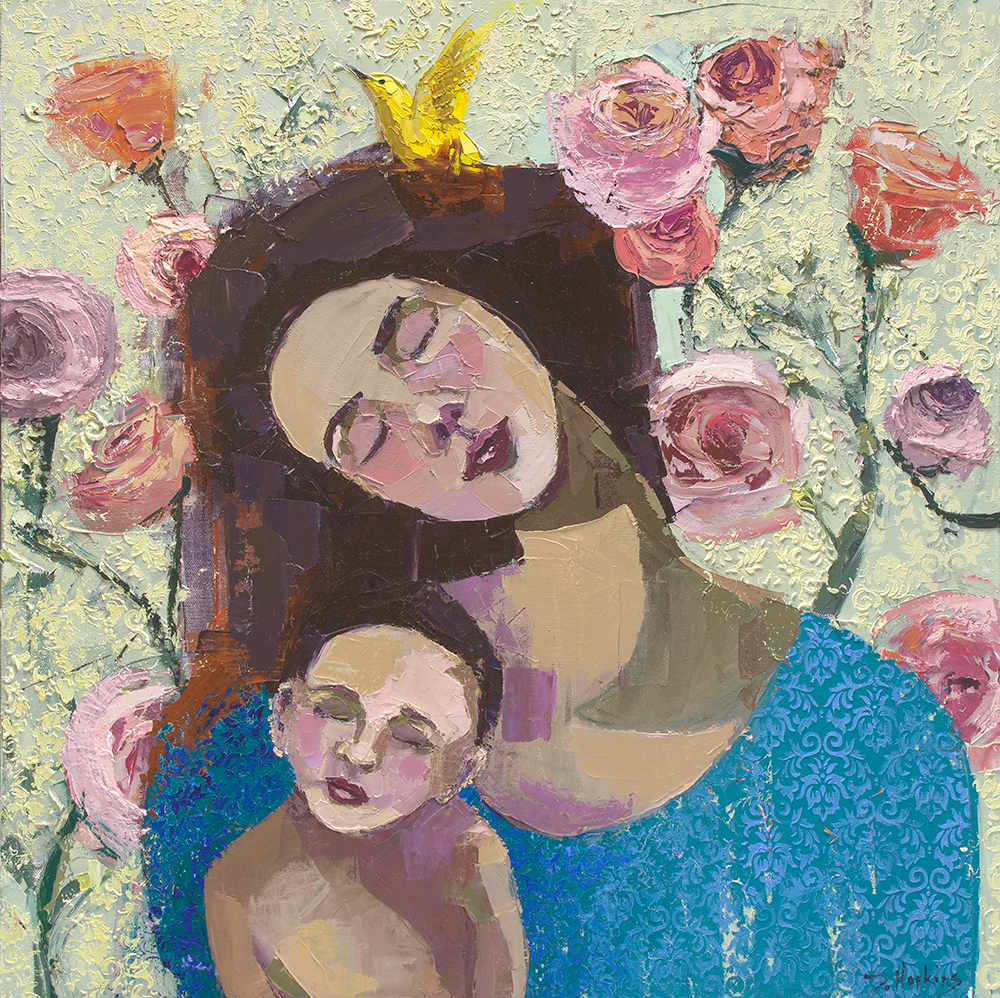
There is a particular freedom that comes from realizing our lives don’t have to resemble the ones we imagined in order to become beautiful. Sometimes we spend years grieving a story that never happened instead of crafting an even more interesting one. As I painted Dreams, I found myself returning to that proverb.
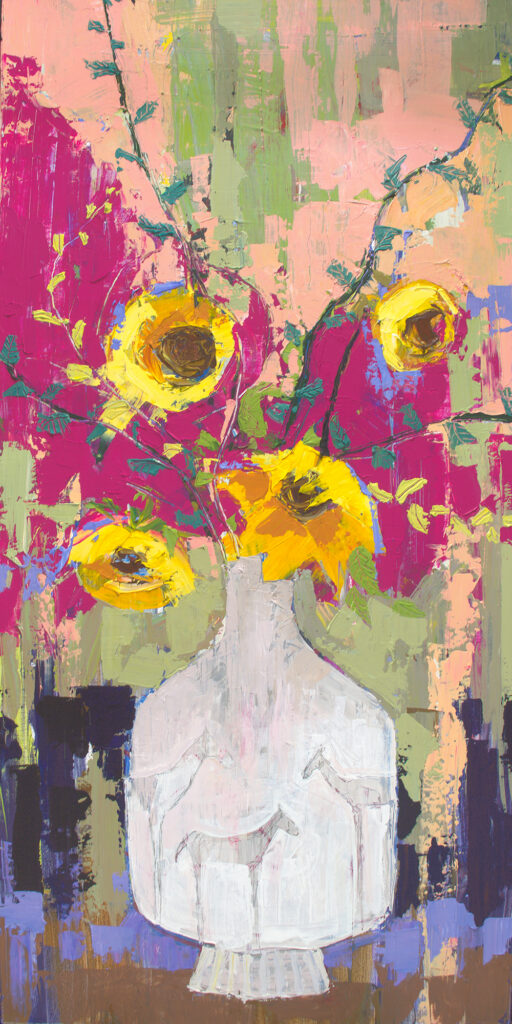
The sleeping mother isn’t dreaming about a different life. She is resting peacefully inside the one she has been given, even with all the uncertainty inherent to raising a child. The child leans into her without effort. A small gold bird rests above her—a quiet symbol of hope, the unexpected gifts that arrive when we loosen our grip on absolute conviction. Around them, flowers bloom in abundance, as if to suggest that life has a way of flourishing beyond the edges of our careful expectations.
This painting is about motherhood and how different it looks from the version I once imagined.
But it’s also about all the places where life has surprised me.
It’s about learning that dreams don’t always disappear. Sometimes they simply change shape. Sometimes they become deeper, kinder, and more expansive than the ones we first carried.
Perhaps that’s what the proverb was trying to teach me all those years ago.
Not that our plans are foolish.
Only that they are wonderfully incomplete.
Somewhere beyond the edges of our imagination is a smiling God—not because our plans are foolish, but because they have so much glorious room to grow.. Because there is always more beauty, more grace, and more life than we can yet conceive.
Artist Note
When I painted Dreams, I was thinking about all the ways life has surprised me. Motherhood, family, and even the place I now call home look nothing like I once imagined, yet each has become a gift I never could have planned. This painting is about finding peace in the life we’ve been given and trusting that grace often has a larger imagination than we do.